chapter onE 

                                         Ayako

Title

In 2010, my mother founded Ayako & Family at her kitchen table. I was sitting across from her in the dim of a single table lamp, huddled over ramekens filled with yogurt and raspberry jam for dessert. The moment was neither declarative nor pensive. "It'll be called Ayako & Family," she said within one simple exhale. We released the word "company" from our vernacular that night, knowing this would exist beyond her but forever within her, as matriarchy does -- perhaps a harbinger for her untimely passing in 2019 and the many ways we have drawn down and expanded on our identity since.

Bon Appétit Magazine called her a busy cross-pollenator. At the time, she was a florist who, on Mondays, would make potstickers to sell by the dozen at the butcher's down the hall from the floral shop. These were not choices but opportunities that welcomed her perseverance. She moved with profound integrity and purpose while her sense of belonging continued to shift around her. She was reconstructing her foundation constantly, veiled by her will to make something beautiful last. "I'm on this train for so long," she'd reflect, "my friends that were here with me, they always get off before I do. But I still stay."


In 2008, a friend in the community made an introduction that would unknowingly stretch her gifts beyond her lifetime. A Japanese farmer in the Yakima Valley by the name of Katsumi Taki hired my mother to be the cashier on Saturdays at his beloved produce stand at the University District Farmers Market. Their connection to food - while vastly different - quickly and gently cohesed at the center fold: fruit.


My mother's father came from a lineage of farmers in the Chiba Prefecture of Japan; what was once vast stretches of agricultural land eventually succumbed to the Narita Airport and suburban developments, and where my grandparents raised us. Her memories survived. In an interview she had for Edible Seattle, she reminisced: "My grandfather had a farm. I remember his tomatoes and corn--and the watermelon we chilled in a well to keep cold. All of the children would line up on the edge of the porch to see who could spit the seeds the farthest." She told this story often to us, as if it was never meant to be left in the past: the innocence, the play, fruit - recently harvested, never precious.

Mair Farm-Taki is owned by Katsumi and his wife, Ryoko. The farm is comprised of 32 vibrant acres, 10 of which has been dedicated to a century-old apricot orchard whose canopy, in June, blankets the sky completely with green and orange. Just beyond that, Taki's cherished plum orchard, home to over 20 unique varieties, sits somewhat obscured from the main tractor paths. His orchard feels unprecedented in its wilderness. Trees have been pruned with intentional restraint, allowing branches to grow towards each other, intertwining from tree to tree, yielding fruit that shifts from yellow to red on a single branch at harvest. 


I remember picking cherries in 2025 with Taki's daughter on the farm, the last year that the farm was in operation. "Since I was a kid..." she trails off, looking up at the constellation of Rainiers. We walked over to her vegetable garden afterwards, a small, fenced in lot dripping in grape vines next to the house. The farm was an oasis tucked away within endless stretches of desert, walled in by its own steep canyons. 


And so, my mother and he converged, like the branches of two orchard trees, or two kids at the edge of a porch. In 2009, my mother came to my apartment, giddy, toting one case of apricots, lightly blemished from the drive over the mountain pass. "Aren't they beautiful?" She remarked, caressing all of their imperfections in the palm of her hand. "I'll turn them into jam."


The partnership was born and our story became that of the partnership. Two dozen plum varieties brought to the world in small, hexagonal glass jars.


In 2016, The New York Times called them delectably sweet-tart and silken. "You're on the front page of the Food Section, mama," my hands shook holding the paper up to her face: her eyes illuminated, still, like the glow of the lamp on that very first evening we gave the business her name. It was the hardest work I knew, so I could see what she was telling me in her eyes. "Let's celebrate, Hisako," she'd say, and we'd fold the exhaustion away and what we knew was imminent in the sweetness of a dessert.


In 2017, my mother was diagnosed with MSA, after almost a decade of progressing illness. Her relationship to food, however fraught, now that she could not bring a spoon to her lips, or stir a pot, reminded me of that unwavering philosophy she had that good food could solve even the most treacherous of conditions. 


"I think your sibling's wild mushroom pasta is curing my speech," she'd giggle through the blur of the ataxia. 


It did not cure her and in 2019, my mother departed, finally, on a rain-soaked Saturday afternoon. The farmers market went on, as it would, and in our place, a small five-foot tent was pitched with a table, a notebook, and a pail of tulip stems next to Taki's booth.


"Your mother is "ame onna," my auntie, said that day through her tears. "She brings the rain wherever she goes," and it was then that I knew she had finally gotten off that train. I swiftly, without looking back, stepped on.


Photo Credits: Sonja Lyon, Aran Goyoaga, Sako Gordon, Jesse Oh

Title
Title

chapter TWO

                                         & Family

We entered the farmers markets in Seattle back in 2017, also marking the formal transition of business ownership from my mother down to my generation. I was in Seattle working in restaurants, at that point, for nearly a decade. My mother and I shared a community: the flowers she arranged adorned the tables of many of the restaurants in which I worked; where friends of mine communed; where her and I would visit on our days off, in our best clothes and brushed out hair, for just a single beer. These were our homes away from home, the meals satiated us with the warmth and togertherness we sought, especially as life shifted dramatically over those few years. 

And of course, her legacy -- the re-building, the endless well of beauty and imagination, the defiance of very tangible limitations -- I refused to abandon any of it. Call it expectation or a way to reconcile the loss, but it felt unjust for her to live her very last days without the possibility of renewal and continuation, through us and through me. I remember her saying, "Jam is so honest, fruit is so honest, but I never ever thought I would be a jam maker." But here we were, at the convergence of the past and the future, two of us suddenly assuming an identity we would share for as long as it was allowed, a combination of willing and fate. This is the liminal space that multi-generational businesses must occupy through their many lifetimes, should they survive the unrelenting nature of time simply passing.

Over the last decade, it has been an honor to bring her with me, to show her the possibility of expanding into this world. Ancestral lineage and nostalgia continue to ground us, even as we close the chapter on our multi-decade partnership with Mair Farm-Taki succeeding his retirement. I have, in its wake, the pleasure of deepening our responsibility within the community, with regard to sustainable longevity, as I, too, begin again. We want to continue to be a place, a bite, an aroma, a sound you can return to, with people at the forefront: new farmers, our employees, our customers, storytellers, and artists. And, as a child of migratory identities, I am reminded that it is the diaspora and those with histories of displacement who know not to resist the dynamic relationship we have to our surroundings when definitions of belonging must be sourced within us, within our most formative recollections of place, while the places we belong to inevitably change around us. That is time passing.


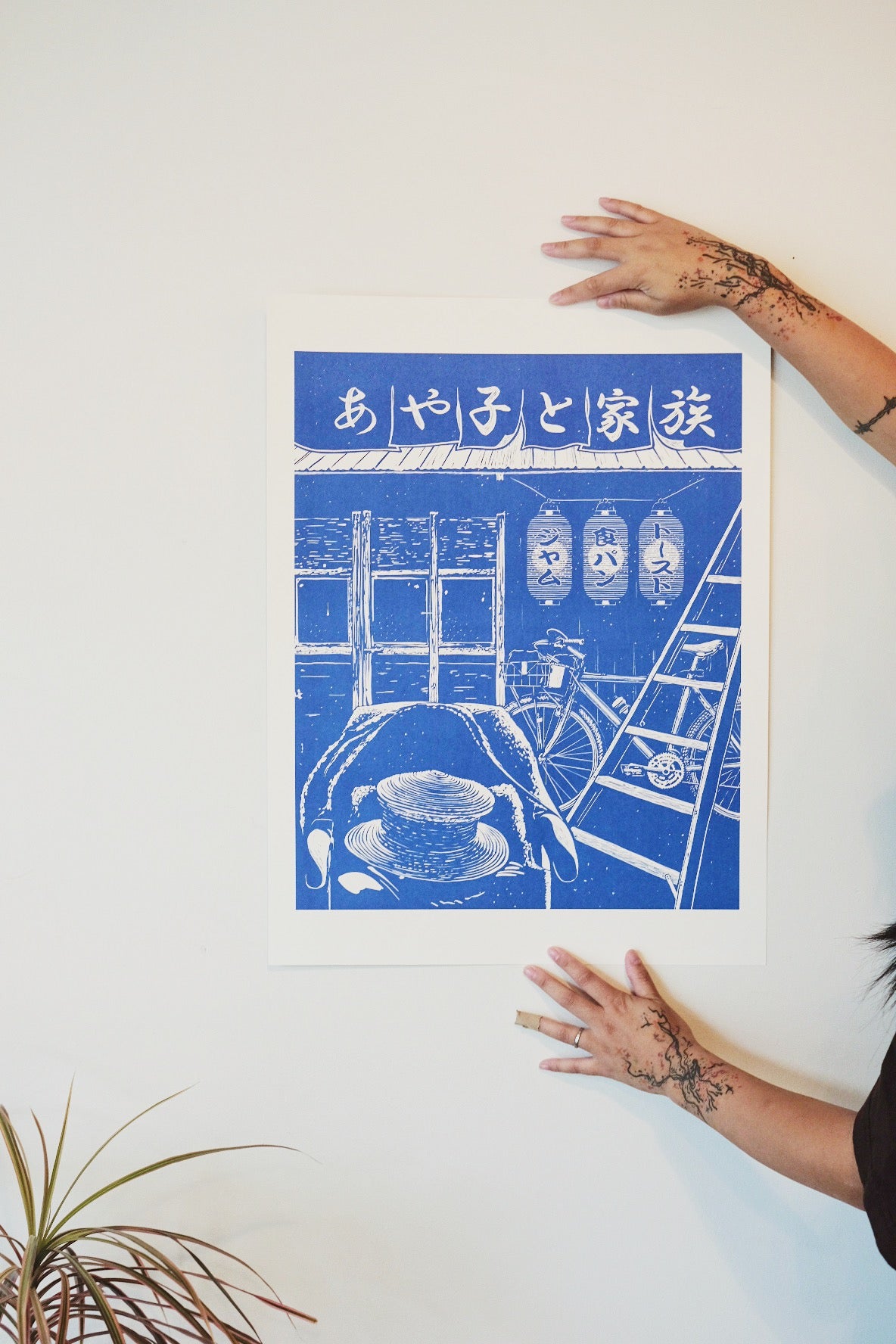
The Farmers Markets continues to serve as home for us for now and has become a beautiful, revolving doorway into new expressions of food and other forms of collaboration. I get to revisit our past through the new. Our shokupan toast, yogurt ice cream, and the jams swirl around in my heart, with a type of childlike comfort. Bringing our bread program to life continues to honor my grandparents, who raised me on milk bread and margarine, and the occasional vanilla soft serve cone from the konbini at 6am with my grandpa before my grandmother woke.


In 2024, I remember cooking Kyoto-sourced red bean "mame" into fresh anko with Sonoko Sakai in my jewel-box kitchen in Seattle. It was to slather onto our toast for our expanded market menu in celebration of her cookbook. "Here," as she dumps a dozen mottled yellow skinned citrus from her bag onto my bakers bench. "I brought yuzu from my yard in LA, we can zest them for the toast." She puts one right up to my nose and I am immediately transported back to my mother peeling a single strip of yuzu zest into miso soup one night. "This is the only yuzu left from Taki's harvest. We must savor it," she nodded.


In 2025, we served fresh mint infused pandan coconut milk over ice in the middle of Wallingford Park. With our friend Bao of Phin Vietnamese Coffee, under the shade of our market tent in the hot summer sun, we watched people pause on our plastic rattan-molded stools for green onion egg toast, seasoned only with soy sauce - the way we both enjoyed eggs as children. "You are making the rat work like an ox," he said to me, as he helped me haul hundreds of pounds of market supplies by foot across the park. "You are too bold, Hisako," my mother frequently said to me. "But you can do anything."


But I never do it alone. We are currently in partnership with a selective number of Washington's best independently-owned and operated farms, including but not exclusive to:


Cabrera Farm

Collins Family Orchards

Grouse Mountain Farm

Midori Farm

Suyematsu Farm


We look forward to continuing to sustain this legacy together, through food and through our histories. Because perhaps one day, I hope, we might sit side by side, under the dim of a table lamp, over a bowl of dessert that I've made, and discuss what you want to name your dreams, just as she did.


Sako Gordon, Owner, Ayako & Family